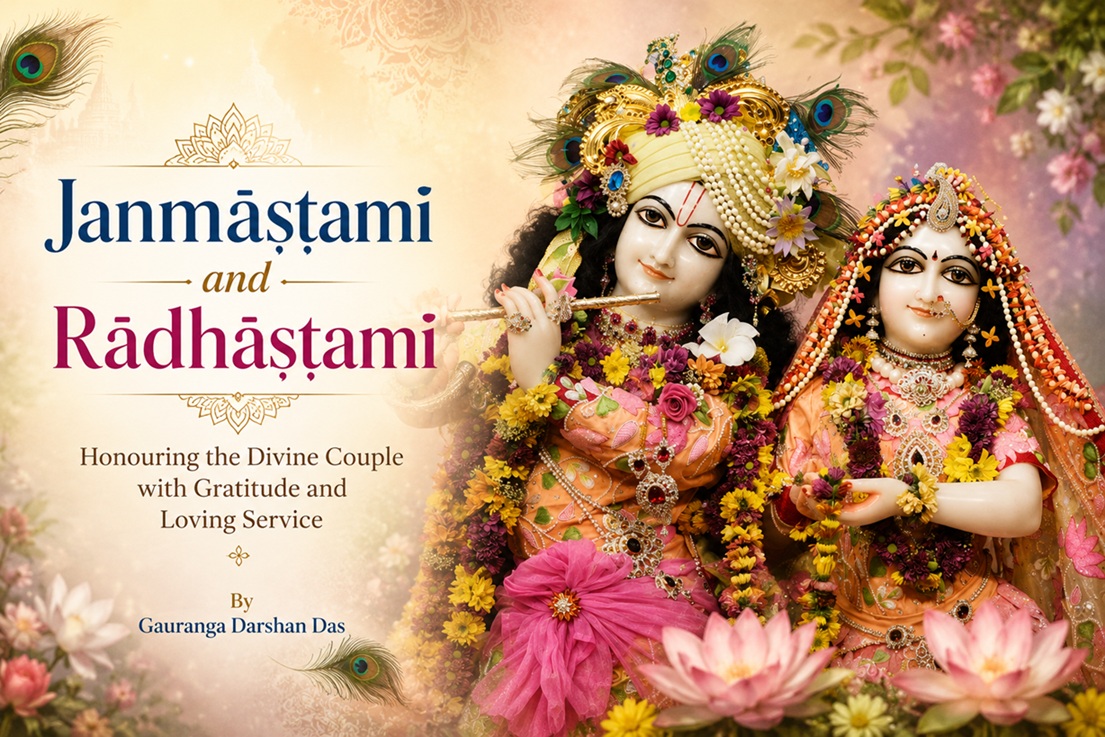
Janmāṣṭamī and Rādhāṣṭamī: Honouring the Divine Couple with Gratitude and Loving Service
Every year, devotees across the world joyfully celebrate two of the most cherished festivals in the Vaiṣṇava calendar—Śrī Kṛṣṇa Janmāṣṭamī and Śrī Rādhāṣṭamī, the auspicious appearance days of Śrī Kṛṣṇa and Śrīmatī Rādhārāṇī. Temples adorned with flowers and sparkling decorations resound with melodious kīrtanas and hari-kathā as devotees celebrate these sacred occasions through worship, chanting, dancing, fasting and feasting.
Yet these festivals are far more than annual commemorations of two divine appearance days. Together, they reveal the heart of Gauḍīya Vaiṣṇava theology. Kṛṣṇa is the supreme object of love, while Śrīmatī Rādhārāṇī is the supreme embodiment of love for Him. Kṛṣṇa enchants the entire universe (jagan-mohana), yet Śrī Rādhā enchants even Kṛṣṇa Himself (jagan-mano-mohana-citta-mohinī).
Janmāṣṭamī invites us to meditate on Śrī Kṛṣṇa's unlimited beauty, sweetness and compassion, while Rādhāṣṭamī invites us to contemplate on Śrīmatī Rādhārāṇī's unparalleled devotion and seek Her blessings to develop sincere devotion for Kṛṣṇa.
In truth, these two appearances are inseparable, complementary manifestations of divine compassion. Kṛṣṇa appears to bestow His association upon the conditioned souls and delight His eternal devotees with His enchanting pastimes. Śrīmatī Rādhārāṇī appears to reveal the supreme glory of selfless, pure devotion to Kṛṣṇa. We are eternal aṁśas of Kṛṣṇa (Bhagavad-gītā 15.7), and whatever devotion awakens within our hearts is but a tiny aṁśa of Śrīmatī Rādhārāṇī's limitless devotion, bestowed upon us by Her causeless mercy.
The Compassion Behind Kṛṣṇa's Descent
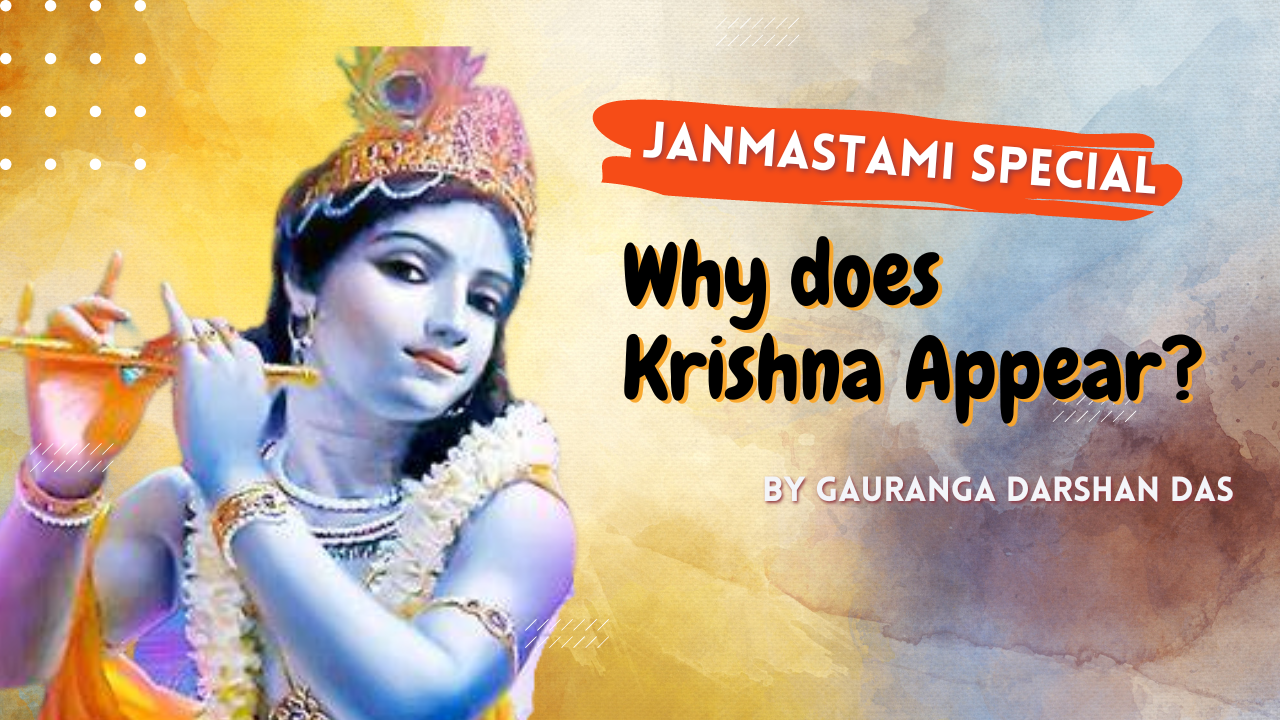
The circumstances of Kṛṣṇa's appearance beautifully reveal both His majesty and His sweetness. He first appeared before Vasudeva and Devakī in the prison of Kaṁsa in His majestic four-armed form, inspiring them to offer heartfelt prayers in awe and reverence. By His inconceivable potency, He simultaneously manifested in Gokula as the beloved son of Nanda Mahārāja and Mother Yaśodā. Thus, in Mathurā He revealed His aiśvarya, or divine majesty, while in Vraja He revealed His incomparable mādhurya, His intimate sweetness.
Unlike ordinary living beings, Lord Kṛṣṇa does not appear under the force of karma. His appearance is entirely transcendental, arising solely from His own independent will. Therefore, He declares in the Bhagavad-gītā:
janma karma ca me divyam evaṁ yo vetti tattvataḥ
tyaktvā dehaṁ punar janma naiti mām eti so 'rjuna
"One who knows the transcendental nature of My appearance and activities does not, upon leaving the body, take birth again in this material world, but attains My eternal abode, O Arjuna." (Bhagavad-gītā 4.9)
The Lord descends to protect His devotees, curb the influence of the wicked and re-establish the principles of dharma. Yet beyond these well-known purposes lies an even more intimate reason for His appearance—to reciprocate with the love of His devotees. His descent is not merely a divine intervention in history but an invitation to every soul to revive its eternal relationship of loving reciprocation with Him.
Śukadeva Gosvāmī beautifully reveals this confidential purpose:
anugrahāya bhaktānāṁ manuṣaṁ deham āśritaḥ
bhajate tādṛśīḥ krīḍā yāḥ śrutvā tat-paro bhavet
"To bestow His mercy upon His devotees, the Supreme Lord accepts a humanlike form and performs such wonderful pastimes that anyone who hears about them becomes devoted to Him." (Śrīmad-Bhāgavatam 10.33.36)
Kṛṣṇa appears not merely to demonstrate His supremacy but to reveal His affection through His enchanting pastimes with His pure-hearted devotees, especially the residents of Vṛndāvana. There He lovingly reciprocates in the mellows of servitorship, friendship, parental affection and conjugal love. Although He is the all-powerful Supreme Lord, He willingly becomes conquered by the love of His devotees (bhaktair jitatvam). In doing so, He proclaims the unparalleled glory of bhakti, the supreme spiritual path that reconnects the eternal soul with its beloved Lord.
Janmāṣṭamī thus offers us an opportunity to meditate deeply on Kṛṣṇa's boundless compassion. Although we have forgotten Him for countless lifetimes and become entangled in material existence, He has never forgotten us, rather accompanies us as the Supersoul within our hearts, patiently guiding us, witnessing our struggles, and waiting for the day we voluntarily turn toward Him. Out of His causeless mercy, He descends into this world, performs captivating pastimes, speaks timeless wisdom through the Bhagavad-gītā, and sends His pure devotees and scriptures to repeatedly remind us of our eternal relationship with Him. His desire is not to punish the conditioned souls but to reclaim them with love.
Therefore, Janmāṣṭamī is much more than a celebration of Kṛṣṇa's appearance in Mathurā over five thousand years ago. It is an opportunity to pause and reflect upon His unending efforts to bring us back to Him. As we gaze upon the beautiful Deities, hear the narrations of His divine pastimes and chant His holy names, our hearts can naturally respond with gratitude. We may pray, "My dear Lord Kṛṣṇa, You descended from Your eternal abode solely to bestow Your mercy upon us. You performed enchanting pastimes to attract our hearts, spoke the Bhagavad-gītā to guide us, and continue to reach out to us through Your empowered devotees. Please help me recognise Your compassion, respond to Your loving invitation, and dedicate my life more sincerely to the path of bhakti."
The Lord's appearance in the dark prison of Kaṁsa is also deeply symbolic. Just as His presence immediately dispelled the darkness of that prison, His presence in our hearts dispels the darkness of ignorance, fear and material attachment. When we sincerely invite Kṛṣṇa into our lives through devotional service, He gradually transforms our consciousness, replacing despair with hope, confusion with wisdom, and material anxiety with the joy of loving service.
And the highest expression of that loving service is personified by Śrīmatī Rādhārāṇī. If Kṛṣṇa's compassion inspires us to dedicate our lives to Him, Śrīmatī Rādhārāṇī's spotless devotion inspires and empowers us to love Him in the purest possible way. It is to Her sublime example and boundless mercy that we now turn.
The Gift of Śrīmatī Rādhārāṇī's Appearance
Rādhāṣṭamī invites us to marvel at the unsurpassed glory of the one who loves Kṛṣṇa the most. Just as the flower and its fragrance are inseparable, Śrī Śrī Rādhā and Kṛṣṇa are eternally united, together revealing the complete truth of divine love.
Śrīmatī Rādhārāṇī manifested in the home of King Vṛṣabhānu and Queen Kīrtidā in the sacred land of Vraja. Although She appeared as an exquisitely beautiful child, She kept Her eyes closed from birth. When Mother Yaśodā visited with baby Kṛṣṇa in Her arms, Rādhārāṇī opened Her eyes for the very first time, beholding His enchanting face. This cherished pastime beautifully conveys that Her entire existence is meant for Kṛṣṇa. Every aspect of Her being is dedicated to His service, His pleasure, and His glory.
For this reason, Śrīla Kṛṣṇadāsa Kavirāja Gosvāmī introduces Śrīmatī Rādhārāṇī with one of the most profound descriptions: devī kṛṣṇa-mayī proktā rādhikā para-devatā (Caitanya-caritāmṛta, Ādi-līlā 4.83).
The expression kṛṣṇa-mayī means "completely pervaded by Kṛṣṇa" or "filled with Kṛṣṇa." It signifies far more than constant remembrance of Kṛṣṇa. Every faculty of Śrīmatī Rādhārāṇī's being exists solely for Him. Her eyes delight in beholding His beautiful form, Her ears rejoice in hearing His names and pastimes, Her voice finds fulfilment in glorifying Him, and Her hands eagerly engage in His service. Her intelligence seeks only what will increase His happiness, and Her heart knows no desire apart from His pleasure. Even Her slightest smile, glance or movement exists only to bring joy to Kṛṣṇa.
Ordinary devotion often begins with our own needs. We approach the Lord seeking happiness, protection, guidance or purification. Śrīmatī Rādhārāṇī's love, however, is entirely selfless. Her only concern is Kṛṣṇa's happiness, and His happiness is Her life's fulfilment. Thus, She is not merely the greatest devotee of Kṛṣṇa but the very personification of pure devotion. Kṛṣṇa is the perfection of the Absolute Truth, while Śrīmatī Rādhārāṇī is the perfection of devotion to that Absolute Truth. Although we can never imitate Her devotion, we can seek Her shelter and pray for even a particle of Her selfless mood. Whatever devotion awakens within our own hearts is but a tiny reflection of Her limitless love.
Indeed, Lord Kṛṣṇa Himself explains that genuine devotees are sheltered by His divine internal energy:
mahātmānas tu māṁ pārtha daivīṁ prakṛtim āśritāḥ
bhajanty ananya-manaso jñātvā bhūtādim avyayam
"O son of Pṛthā, those who are not deluded, the great souls, are under the protection of the divine nature. They are fully engaged in devotional service because they know Me as the Supreme Personality of Godhead, original and inexhaustible." (Bhagavad-gītā 9.13)
Śrīla Prabhupāda explains: "In the above-quoted verse from Bhagavad-gītā, the words daivīṁ prakṛtim refer to the control of the internal potency, or pleasure potency, of the Supreme Personality of Godhead. This pleasure potency is manifested as Śrīmatī Rādhārāṇī, or Her expansion Lakṣmī, the goddess of fortune. When the individual jīva souls are under the control of the internal energy, their only engagement is the satisfaction of Kṛṣṇa, or Viṣṇu. This is the position of a mahātmā." (Nectar of Instruction 2)
Thus, genuine devotion to Kṛṣṇa flourishes under Śrīmatī Rādhārāṇī's compassionate shelter. We approach Kṛṣṇa most naturally and most successfully by taking shelter of the one who loves Him perfectly.
With this understanding, we celebrate Rādhāṣṭamī not merely as the appearance day of an exalted devotee but as the advent of the Supreme Goddess of Devotion, who nourishes our relationship with Kṛṣṇa. By glorifying and worshipping Her, we pray to replace self-interest with selfless service, and material expectations with wholehearted dedication to Kṛṣṇa's satisfaction.
The true significance of Rādhāṣṭamī, therefore, is not simply to admire Śrīmatī Rādhārāṇī's devotion but to pray for a drop of it. As we sincerely seek Her shelter, our hearts gradually become reoriented toward Kṛṣṇa's happiness rather than our own, allowing us, however faintly, to understand the profound meaning of becoming kṛṣṇa-maya.
Janmāṣṭamī reveals the all-attractive Lord, while Rādhāṣṭamī reveals the supreme embodiment of love whose devotion captivates even Him. Together they unveil the complete science of bhakti, teaching us not only whom to love, but also how to love Him.
Honouring the Divine Couple in Our Lives
The festivals of Janmāṣṭamī and Rādhāṣṭamī are not merely occasions for remembering sacred events of the past. They are invitations to transform our devotional lives.
Janmāṣṭamī reminds us that the Supreme Lord is not an impersonal force or a distant ruler beyond the reach of His devotees. He is the all-attractive Śrī Kṛṣṇa, whose beauty captivates every heart and whose compassion draws even the most fallen souls toward Him.
Rādhāṣṭamī, in turn, reveals the spirit in which the loving invitation from Kṛṣṇa is to be accepted. Śrīmatī Rādhārāṇī demonstrates that the essence of devotion lies not in what we receive from Kṛṣṇa, but in seeking His happiness. Her spotless devotion reveals the perfection of selfless love. As Śrīla Kṛṣṇadāsa Kavirāja Gosvāmī explains:
ātmendriya-prīti-vāñchā—tāre bali 'kāma'
kṛṣṇendriya-prīti-icchā dhare 'prema' nāma
"The desire to gratify one's own senses is called kāma (lust), whereas the desire to please the senses of Lord Kṛṣṇa is called prema (love)." (Caitanya-caritāmṛta, Ādi-līlā 4.165)
This profound teaching has practical implications for every devotee. Love naturally expresses itself through service with pure intention. Whether offering a flower, worshipping the Deities, chanting the holy names, serving the Vaiṣṇavas, or performing the smallest task, every act becomes spiritually beautiful when done solely for Kṛṣṇa's pleasure. Cleanliness in the temple, attentiveness in worship, punctuality in service, and sincerity in our dealings are not mere disciplines—they are expressions of love.
Another hallmark of Śrīmatī Rādhārāṇī's devotion is complete freedom from selfishness. This same spirit shines throughout Vṛndāvana. The Vrajavāsīs rejoice whenever Kṛṣṇa is pleased, regardless of who receives the opportunity to serve Him. Their happiness lies not in personal recognition but in His satisfaction. As we learn to celebrate Kṛṣṇa's pleasure above our own prestige and preferences, our hearts become purified and our devotion deepens.
Ultimately, Rādhāṣṭamī invites us to become, in our own small measure, kṛṣṇa-maya. We can never imitate Śrīmatī Rādhārāṇī's limitless love, yet we can sincerely aspire to follow Her example. Spiritual advancement is nothing but the gradual reorientation of our lives toward Kṛṣṇa. Little by little, our thoughts, words and actions become centred on His pleasure.
Śrīla Rūpa Gosvāmī beautifully describes the transformation that takes place in the heart of one whose life becomes absorbed in Kṛṣṇa:
nāmāni praṇayena te sukṛtināṁ tanvanti tuṇḍotsavaṁ
dhāmāni prathayanti hanta jalada-śyāmāni netrāñjanam
sāmāni śruti-śaṣkulīm muralikā-jātāny alaṅkurvate
kāmānīvṛta-cetasām iha vibho nāśāpi naḥ śobhate
"Now that we have become Your devotees, Your holy names have affectionately created a jubilant festival in our mouths. Your bodily splendour, like a dark raincloud, has become the black ointment of our eyes, and the music of Your flute has become the ornament of our ears. We no longer take pleasure in material things. O Almighty Lord, material pleasures no longer appear beautiful to us."
(Padyāvalī 59)
When the heart becomes absorbed in Kṛṣṇa, His holy names become a festival for the tongue, His beautiful form becomes the ointment for the eyes, and the sound of His flute becomes the ornament of the ears. Material attractions eventually lose their hold, not through forced renunciation, but because one has discovered a higher taste. Such is the transformation inspired by the mercy of Śrīmatī Rādhārāṇī.
The Gauḍīya Vaiṣṇava tradition reaches its most beautiful culmination in the appearance of Śrī Caitanya Mahāprabhu. Śrīla Kṛṣṇadāsa Kavirāja Gosvāmī explains that Śrī Caitanya is none other than Śrī Śrī Rādhā-Kṛṣṇa united in one form:
rādhā-kṛṣṇa-praṇaya-vikṛtir hlādinī-śaktir asmād
ekātmānāv api bhuvi purā deha-bhedaṁ gatau tau
caitanyākhyaṁ prakaṭam adhunā tad-dvayaṁ caikyam āptaṁ
rādhā-bhāva-dyuti-suvalitaṁ naumi kṛṣṇa-svarūpam
(Caitanya-caritāmṛta, Ādi-līlā 1.5)
Although Śrī Rādhā and Kṛṣṇa are eternally one, They manifested as two to relish the sweetness of Their loving exchanges. Later, They appeared as one again in the form of Śrī Caitanya Mahāprabhu, with Kṛṣṇa accepting the mood and golden complexion of Śrīmatī Rādhārāṇī in order to experience the glory of Her love for Him. Yet He did not come merely to relish that love Himself. He came to distribute it freely through the congregational chanting of the holy names.
Recognising this unparalleled compassion, Śrīla Rūpa Gosvāmī offered his celebrated prayer:
namo mahā-vadānyāya
kṛṣṇa-prema-pradāya te
kṛṣṇāya kṛṣṇa-caitanya-
nāmne gaura-tviṣe namaḥ
"I offer my respectful obeisances unto the most munificent incarnation, Śrī Kṛṣṇa Caitanya, who is Kṛṣṇa Himself appearing with a golden complexion to freely bestow love of Kṛṣṇa."
Thus, the celebrations of Janmāṣṭamī and Rādhāṣṭamī naturally lead us to the lotus feet of Śrī Caitanya Mahāprabhu. Janmāṣṭamī reveals the Supreme Beloved. Rādhāṣṭamī reveals the supreme embodiment of love for that Beloved. And Śrī Caitanya Mahāprabhu reveals that this divine love is not reserved for a select few, but is freely offered to every sincere soul.
As we celebrate these sacred festivals, may Janmāṣṭamī deepen our appreciation for Śrī Kṛṣṇa, may Rādhāṣṭamī awaken within us a longing to follow the spotless devotion of Śrīmatī Rādhārāṇī, and may the causeless mercy of Śrī Caitanya Mahāprabhu and His followers purify our hearts so that every thought, every word and every action may be offered for the pleasure of Śrī Śrī Rādhā-Kṛṣṇa.
For the true purpose of honouring the Divine Couple is not merely to celebrate Their appearance with flowers, songs and festivals, but to allow Their divine love to reshape our hearts. As we honour Janmāṣṭamī and Rādhāṣṭamī year after year, may we gradually learn to love Kṛṣṇa under the compassionate guidance of Śrīmatī Rādhārāṇī. Then Janmāṣṭamī and Rādhāṣṭamī will no longer be merely annual festivals; they will become the guiding inspiration of our lifelong practice of bhakti.
Gaurāṅga Darśana Dāsa, a disciple of His Holiness Rādhānāth Swami, is dean of Govardhan School of Education and Culture at ISKCON GEV. He is the author of fifty-three books, including the Subodhini series of study guides, children’s books such as Bhāgavatam Tales, and other self-enrichment books. He offers online and residential scriptural courses for adults and children worldwide.